
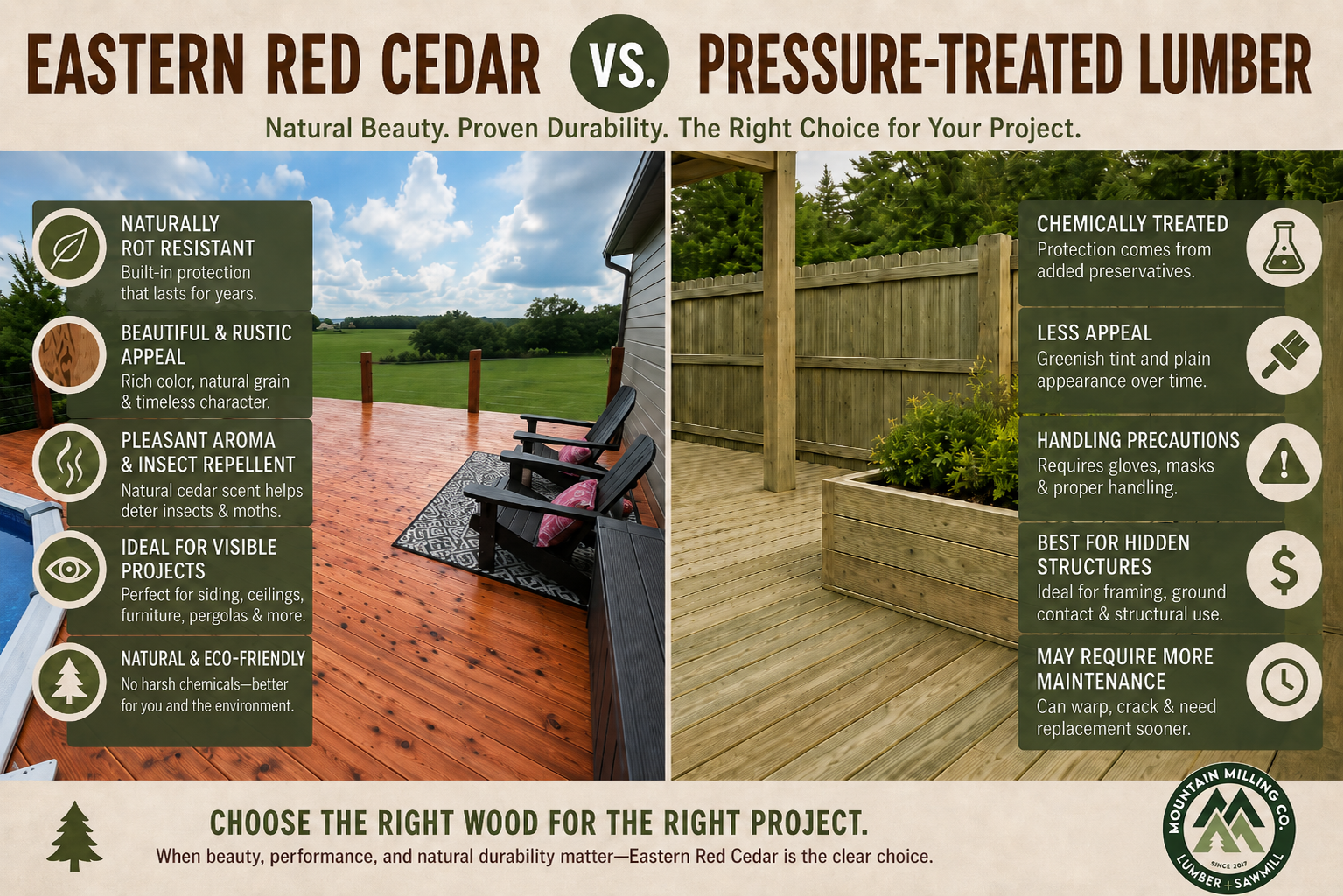
Every now and then, someone asks us a fair question:
“Why should I choose Eastern Red Cedar when pressure-treated lumber is cheaper?”
And honestly, it’s a good question. Pressure-treated lumber has earned its place in the building world. It’s common, affordable, and designed to resist decay in tough outdoor conditions. But Eastern Red Cedar brings something different to the table — something natural, beautiful, aromatic, and time-tested.
So let’s walk through the differences between Eastern Red Cedar lumber and pressure-treated lumber, where each one makes sense, and why cedar may be the better choice for projects where appearance, natural resistance, and long-term enjoyment matter most.
What Is Pressure-Treated Lumber?
Pressure-treated lumber is usually softwood, often southern yellow pine, that has been placed into a treatment chamber where chemical preservatives are forced deep into the wood. The goal is simple: help the lumber resist fungal decay, insects, and moisture-related damage.
The USDA Forest Products Laboratory explains that wood used outdoors or in moist conditions can be vulnerable to fungal decay and insect damage, and pressure treatment is one of the most common ways to protect wood from that type of biological deterioration.
Modern residential pressure-treated lumber often uses EPA-registered preservatives such as alkaline copper quaternary, commonly called ACQ, and copper azole. These preservatives are designed to help prevent decay from fungi and insects, and the EPA notes that newer residential wood preservatives generally have lower toxicity profiles than older treatments.
In other words, pressure-treated lumber works. It has a purpose. It is often a practical choice for deck framing, ground-contact structural work, retaining walls, and places where cost and code requirements matter more than appearance.
But that doesn’t mean it is always the best choice.
What Is Eastern Red Cedar Lumber?
Eastern Red Cedar, also called aromatic red cedar, is a naturally durable softwood known for its rich color, unmistakable scent, and resistance to decay and insects. The USDA describes Eastern Red Cedar as having a fine, uniform, straight grain and says it is favored for its cutting qualities, durability, rich color, and aroma. The same source notes that it has long been used for fence posts, chests, wardrobes, and closet linings.
Unlike pressure-treated lumber, Eastern Red Cedar does not need chemical preservatives to gain its rot- and insect-resistant qualities. Those benefits come naturally from the wood itself.
The Wood Database lists Eastern Red Cedar with a Janka hardness of 900 lbf and describes it as excellent in resistance to both decay and insect attack. It also notes that aromatic red cedar is commonly used for fence posts, closet and chest linings, outdoor furniture, birdhouses, and other specialty wood products.
That combination of beauty, scent, durability, and workability is what makes Eastern Red Cedar such a useful option for homeowners, DIYers, woodworkers, and builders.
Advantage #1: Eastern Red Cedar Is Naturally Rot-Resistant
Pressure-treated lumber resists rot because preservatives are added to it. Eastern Red Cedar resists rot because that is part of how the wood was made.
That natural resistance is one of cedar’s biggest advantages. For projects like fence posts, pergolas, raised garden beds, porch ceilings, covered outdoor areas, and rustic structures, Eastern Red Cedar offers long-lasting performance without depending on a chemical treatment process.
That does not mean cedar is magic. Like any wood, it performs best with smart installation practices, good drainage, airflow, and proper finishing when needed. But when used correctly, cedar holds up beautifully.
Advantage #2: Cedar Looks Better Where the Wood Will Be Seen
Pressure-treated lumber is often chosen for hidden structural parts of a project. It works well under a deck, inside framing, or anywhere function matters more than appearance.
Eastern Red Cedar, on the other hand, is a wood you actually want people to see.
Its reddish and violet-brown heartwood, pale sapwood streaks, fine texture, and knotty character give it a warmth that pressure-treated lumber simply cannot match. The Wood Database describes Eastern Red Cedar heartwood as reddish or violet-brown, with pale yellow sapwood that can appear as streaks and stripes throughout the board.
That makes cedar a great choice for:
- Tongue and groove ceilings
- Shiplap accent walls
- Covered porch ceilings
- Pergolas and gazebos
- Decorative beams and posts
- Closet linings
- Garden beds
- Rustic furniture
- Trim and moulding
If the lumber is going to be visible, Eastern Red Cedar usually gives you a more finished, intentional, and natural look.
Advantage #3: Cedar Smells Like Cedar — and That Matters
One of the first things people notice about Eastern Red Cedar is the smell.
That aroma is not just pleasant. It is part of what has made cedar useful for generations. Eastern Red Cedar is commonly used in closets and chests because its aroma helps repel moths and other insects.
That makes cedar especially useful for indoor projects like closet liners, wardrobes, storage chests, drawer bottoms, and other areas where you want the wood to be both functional and enjoyable.
Pressure-treated lumber does not offer that benefit. It is built for preservation, not aroma, beauty, or indoor comfort.
Advantage #4: Cedar Is Easier to Love in Home and Garden Projects
For homeowners, the choice often comes down to how the project will be used.
If you are building hidden framing under a deck, pressure-treated lumber may be the practical choice. But if you are building something your family will sit near, touch, smell, or see every day, Eastern Red Cedar starts making a lot more sense.
That is especially true for raised garden beds and planters. Many customers prefer cedar for garden projects because it is naturally rot-resistant and does not rely on added preservatives for durability.
Pressure-treated lumber can be used safely when handled according to product guidance, but treated wood does come with extra precautions. The National Pesticide Information Center says the chemicals used in treated wood can pose risks to human health and the environment if not handled properly, and recommends precautions such as wearing gloves, using dust protection when cutting or sanding, washing hands after handling, and keeping food from contacting treated wood.
For folks who want a more natural material around vegetables, herbs, flowers, pets, and children, Eastern Red Cedar is often the more comfortable choice.
Advantage #5: Cedar Is Better for Projects Where Touch and Finish Matter
Pressure-treated lumber is often wet when purchased and may need time to dry before staining or sealing. It can also be harder on fasteners depending on the treatment type, and cuts or drilled holes sometimes need extra attention.
Eastern Red Cedar is generally easy to work with. The Wood Database notes that aromatic red cedar is easy to work overall, though knots and silica content can dull cutters over time. It also glues and finishes well, though many people leave it unfinished in certain applications to preserve the aroma.
That makes cedar a strong choice for projects where fit, finish, and feel matter, including ceiling boards, wall paneling, trim, furniture, and decorative woodworking.
Advantage #6: Cedar Has Fewer Disposal and Handling Concerns
This is another place where the two woods are very different.
Pressure-treated lumber should be handled and disposed of properly. EPA guidance for older chromated arsenical-treated wood says not to burn CCA or other preservative-treated wood in a residential setting because of possible toxic chemicals in the smoke and ash. EPA also recommends goggles, a dust mask, and handwashing when sawing treated wood.
That does not mean modern pressure-treated lumber is bad. It just means it has rules.
Eastern Red Cedar sawdust should still be handled with common sense — use ventilation and a dust mask when cutting or sanding any wood — but cedar does not carry the same preservative-treatment concerns as pressure-treated lumber.
When Pressure-Treated Lumber Still Makes Sense
This post is not here to beat up pressure-treated lumber. It has its place.
Pressure-treated lumber may be the better choice for:
- Deck framing
- Structural ground-contact applications
- Retaining walls
- Hidden framing
- High-moisture areas where appearance does not matter
- Budget-focused projects
- Code-required treated applications
In those situations, pressure-treated lumber can be practical, affordable, and effective.
The key is choosing the right material for the right part of the project.
When Eastern Red Cedar Is the Better Choice
Eastern Red Cedar is often the better fit when the wood will be visible, touched, smelled, or appreciated as part of the finished project.
Choose Eastern Red Cedar for:
- Porch ceilings
- Tongue and groove walls or ceilings
- Shiplap siding or accent walls
- Closet linings and storage chests
- Raised garden beds
- Pergolas and gazebos
- Decorative posts and beams
- Rustic furniture
- Trim, moulding, and finish details
- Outdoor features where natural beauty matters
Pressure-treated lumber may win on hidden utility. Eastern Red Cedar wins when you want the wood itself to be part of the story.
The Simple Comparison
| Feature | Eastern Red Cedar | Pressure-Treated Lumber |
|---|---|---|
| Rot Resistance | Natural | Added through preservatives |
| Insect Resistance | Natural aromatic oils | Added through preservatives |
| Appearance | Rich red tones, knots, character | Often green or brown treated appearance |
| Aroma | Strong cedar scent | No natural aromatic property |
| Best Uses | Visible projects, closets, garden beds, trim, siding, pergolas | Deck framing, ground contact, hidden structural use |
| Handling | Standard wood dust precautions | Extra chemical-handling precautions recommended |
| Food/Garden Comfort | Often preferred for garden beds | Use only according to product guidance |
| Burn/Disposal | Do not burn construction scraps casually, but no added treatment chemicals | Do not burn preservative-treated wood |
Final Thought: Build With the Wood That Fits the Job
At the end of the day, both Eastern Red Cedar and pressure-treated lumber have a place.
Pressure-treated lumber is useful when the main goal is affordable structural protection in rough conditions. Eastern Red Cedar is the better choice when you want natural durability, beautiful grain, rich color, a cedar aroma, and a finished look that feels warm and intentional.
So, if you are building something hidden under a deck, pressure-treated lumber may be just fine.
But if you are building something your family will see, use, smell, gather under, or pass down — cedar has a way of making that project feel a little more special.
At Mountain Milling Co., we believe good wood should do more than hold together. It should bring beauty, character, and purpose to the space it becomes part of. And that is where Eastern Red Cedar shines.
